AI Is Killing How-To Books. What Comes Next?

Tim Ferriss recently wrote an article that bounced around the publishing world. I had a number of people text it to me, asking my opinion.
The bottom line is that I loved the piece (not the data, but his perspective), and I agree with Tim on far more than I disagree. In fact, I think he's correctly diagnosed what AI is killing. What I’m focused on is what comes next.
First and foremost, you should definitely listen to Tim. He’s been one of the most influential voices in modern entrepreneurship and nonfiction over the last two decades. His list of accomplishments as an author – and human being – is unmatched. Breathtaking, really. Look it up.
Second, you should know that I'm biased. Upton Sinclair once said:
"It’s difficult to get a man to understand something when his salary depends on his not understanding it."
I work with authors on these types of books. If anyone on the internet is motivated to conclude “the how-to book is fine, actually,” it’s me. Discount everything accordingly.
That said, I've got a fairly unique vantage point on this topic. I’ve spent 15+ years in publishing, including three years working directly with Tim as his Director of Special Projects and as an editor on The 4-Hour Body. I’ve also worked on books that have sold several hundred thousand copies in the last couple of years. That experience shapes how I see this.
I consider Tim a friend and mentor. I learned a TON in our years working together, and I attribute much of my career's success to his mentorship. I've been very fortunate to stand on the shoulders of giants, and Tim's quite arguably the tallest of the bunch.
This isn't really a rebuttal to Tim. Like I said, Tim is right about what is dying. The business of selling printed information at volume to strangers is in structural decline. What I’m focused on is what remains valuable once that model collapses.
First, Tim's data is brutal
Tim presents the sales numbers from his own catalog, and the drop-off is massive. It can't easily be explained by normal backlist decay.
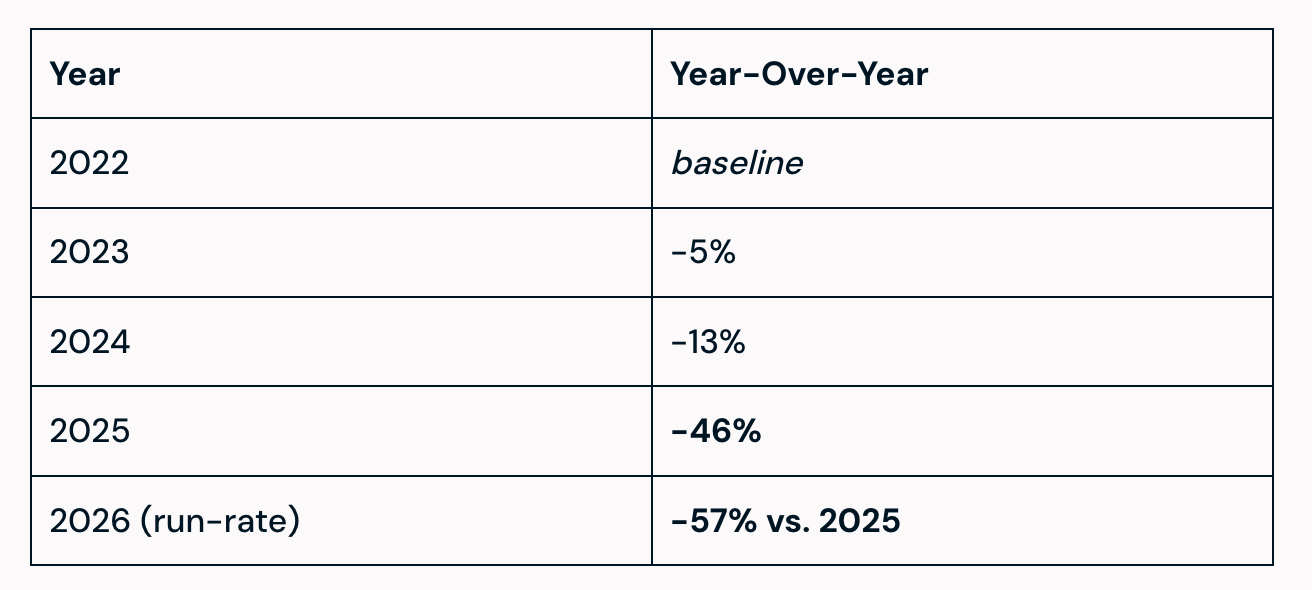
More importantly, the same thing is reportedly happening to other massive self-help franchises. Seth Godin posted in the comments saying he's seeing similar data.
Could there be other explanations? Sure, it's possible. Post-pandemic behavior, aging franchises, changing consumer tastes, etc. But let's assume he's completely right. Let's assume AI caused the entire collapse.
His conclusion is:
“The death of prescriptive nonfiction books, at least as a mass-market information business, is nigh.”
I agree. The important words are “as a mass-market information business.”
The business of selling printed information at volume to strangers is dying. The internet started its decline and AI will finish the job. But selling prescriptive nonfiction to the masses is a business model. It is not the format itself.
The more important question is what the format is still uniquely good at.
What is a prescriptive nonfiction book, really?
Tim has said he views his books through the lens of a teacher who wants to affect change in the greatest number of people possible. That is the real test. Few have done it better than him.
But AI forces a harder question: how much of that change came from the information itself, and how much came from the full experience of the book?
He described this tension in his article:
"On some level, The 4-Hour Body is a lookup table."
I think Tim is underselling the quality of his own work here.
Yes, parts of The 4-Hour Body function like a lookup table. And AI is now an extraordinarily good lookup table. Ask a chatbot how to lose fat, sleep better, or put on muscle, and it can synthesize thousands of sources and give you a personalized answer in seconds. A 600-page book cannot compete with that on retrieval speed.
But The 4-Hour Body was never just a lookup table, and I believe Tim's readers would agree. It’s full of entertaining stories and wild experiments worth talking about. More importantly, it uses Tim himself as the human guinea pig in a way no reference manual can. Newsweek called him “the world’s best guinea pig,” a label he embraced, and that’s a huge part of why the book worked.
Conviction > Information
His own experiment proves this point. Later in Tim's article, he gives us what I think is the best evidence for why books like his work.
When The 4-Hour Body came out, smart friends asked him to skip the long read and send over the bullet points. He did.
Want to guess how many implemented?
“Precisely zero—none of them—implemented the advice.
In contrast, thousands of readers… lost 100+ pounds.”
That's fascinating, because the compressed information wasn't actually the product. His friends had the shorthand answer, just like they do now with AI and book summary sites like Blinkist. And yet, they didn't change.
Meanwhile, thousands of strangers who walked the full designed path in the book changed their lives after failing diets for years.
In a strange way, Tim is a victim of his own success. His books became so influential that AI models can now hand you approximations of his ideas in seconds. But knowing the answer and trusting the source deeply enough to act are different products entirely.
Tim’s books changed millions of lives because of the sequencing, the stories, the designed path, and the relationship of trust he built over hundreds of pages.
That was always the product. The information never was.
A great book and a summary are not the same experience. A great book gives you a human being whose judgment you can evaluate: how they arrived at their conclusions, what happened when they tested them, where they failed, and why they believe what they believe. You come to know, like, and trust them. A summary, by contrast, delivers the information alone.
Information and conviction are different products. A chatbot can synthesize what is known. A thought leader gives you a reason to see the world differently. When answers become abundant, what becomes scarce is judgment, provenance, experience, story, taste, and trust.
AI is rapidly commoditizing the answer. It isn’t obvious that it has commoditized transformation.
Look at how the new winners are selling
Tim correctly points out that a few giant successes don’t disprove a broad market decline. I agree. What’s more interesting is how the recent breakouts sold.
Mel Robbins built a large audience that already trusted her before The Let Them Theory arrived. Alex Hormozi turned the launch of $100M Money Models into an event for an existing audience. Neither relied on the old model of putting information on bookstore shelves and hoping strangers bought it.
The author is now part of the product.
You don’t need millions of followers for this to work. But you do need some way to create trust and reach the right people. As Tim put it:
“Voice, taste, and personality may end up being the only durable moats.”
I’d take it a step further: we increasingly want a relationship with the person who made the thing before we give it our attention.
Books are now subject to the same force that already governs podcasts, newsletters, and YouTube: make us care about the character!
When information is free everywhere, the human delivering it becomes a larger part of why we choose one source over another.
The book as product vs. the book as asset
Traditional publishing has conditioned everyone to measure books by one primary KPI: copies sold.
For many nonfiction authors — such as founders, executives, consultants, speakers, experts — that is not the metric that matters most.
A better KPI is the opportunities the book creates.
The book is the frontend. The real economic value often happens on the backend: clients, speaking, partnerships, deal flow, recruiting, or simply getting the right person to take your call. A strong prescriptive book can function as a passport.
The 4-Hour Workweek is a clear example. It sold millions of copies and turned Tim into one of the most influential thinkers in entrepreneurship. But the royalties were not the only economic outcome. The book gave him extraordinary authority and access. It put him into rooms and relationships that eventually included early investments in companies like Uber, Shopify, Facebook, Twitter, and many others. The downstream value almost certainly dwarfed the royalties. That is the distinction a sales chart cannot measure.

You don’t need millions of readers for this model to work. Cameron Herold laid out the economics to me: handing out 1,000 free copies at an event can produce a ~30X return through coaching and speaking. On a traditional sales chart those copies barely register. To him they can be worth six figures.
If a book’s job is converting the right readers instead of reaching the most readers, a sharp decline in total units does not automatically mean a sharp decline in the value of the asset.
This does not save every how-to author. If your entire business depends on selling $20 books full of information people can now get from AI, the prognosis is grim. Much like a YouTuber relying on AdSense, the math isn't great. But for people with genuine expertise, services, or ideas they want to spread, the strategic value of a great book can behave very differently from its retail sales.
AI changes the supply side, too
This is where I think I'm a bit more optimistic than Tim.
Most of the conversation about AI and books focuses on demand: if AI gives readers answers instantly, fewer people need books. Fair enough.
But AI is also changing the supply side.
For decades, writing a genuinely good 50,000-word manuscript required an enormous amount of time, skill, money, and professional support. That system didn’t just filter for expertise; it filtered for people who could survive the writing process.
AI lowers that barrier. The expert with 20 years of hard-won knowledge and limited writing ability now has a better shot at turning those ideas into a book.
This does not mean asking ChatGPT to “write my book.” When left alone, AI produces average, predictable work (i.e. slop). The job of an author has always been the opposite.
Better tools don’t automatically raise the average. Cheap cameras didn’t automatically create better movies; they just changed who got to take the shot. More access will create more slop (which we're already seeing). But it will also let more people with real experience compete on story, judgment, character, and taste instead of pure writing endurance.
What would prove me wrong?
I'm not arguing that mass-market unit sales will recover. They may not.
My narrower claim is that high-quality nonfiction books will continue to create real value for credible experts even as the market for generic how-to books shrinks.
Three things would prove me wrong:
- Backend value disappears. Over the next 3-5 years, strong books stop generating meaningful clients, speaking, partnerships, or deal flow for the authors who write them.
- The authority premium fades. Being the author of a respected book no longer improves trust, access, or conversion compared to comparable experts without one.
- Transformation loses to compression. Sustained long-form stops producing greater conviction and behavioral change than short-form AI guidance.
Those are testable questions. And if the answers eventually come back against me, I'll change my mind.
Where Tim and I ultimately land
Tim writes:
“I’d rather write books for 10,000 people who are genuinely changed… than crank out short-form videos for 10 million people who forget about them.”
Hell yes. I’m with him completely.
The difference is that I don’t see those 10,000 readers as a consolation prize. For the right author, they are the entire point.
The mass-market information business is finished, exactly as Tim says. What’s left is the book as an asset: proof of expertise, a passport into the right rooms, a trust accelerator, and a tool that can still change the people who read it. Those books were never fully measured by copies sold.
In a note to me, Tim clarified his own priority:
“I definitely appreciate how many authors use their book primarily as a calling card to sell their speaking and consulting. I just don’t want to focus on those ancillary businesses, as I’m viewing my books mostly through the lens of a teacher who wants to affect change in the greatest number of people possible…
I do worry about my ability to reach mass numbers of people with carefully crafted sequencing that actually changes beliefs and behavior…
All that said, I think those times have long past for the majority.”
He may be right. The conditions that once allowed structured long-form to change large numbers of people may have largely disappeared.
Still, books have survived multiple death sentences before. Each time the mass version of the previous form got smaller, something narrower and more intentional took its place. The people who still choose effort and attention in an age of infinite distraction have never been the majority. They have, however, always been the ones most worth reaching.
The next generation of nonfiction will have to earn attention through story, character, judgment, trust, transformation, and genuine expertise. At the same time, AI will give more people than ever a chance to create those books.
The old way is dying. I’m more interested in what gets built next.
On a personal note, I hope Tim writes another book. I’ll be first in line for it, just as I have been for the past two decades.
Thanks for reading.
-Charlie
Member discussion