Your Dreams Just Got a Lot Closer
Eighty million people read Matt Shumer's piece on AI. That's nuts.
In case you missed it, he compared this moment to the early days of COVID. He said he'd been giving people "the polite version... because the honest version sounds like I've lost my mind." Then he told everyone to start experimenting with AI for at least an hour a day.
He's not wrong. I've been building with AI every day for three years. The pace is, indeed, staggering.
But here's what I want to add to the conversation, because I think millions of people heard the alarm and missed the invitation.
Buried near the end of Shumer's piece, almost as an afterthought, he wrote:
"Your dreams just got a lot closer."
That should have been the headline. Because THAT is the "something" in the Something Big Is Happening.
Yes, AI can cause you to lose your $100K/yr job. But it will just as readily help you start a $1M+/yr business. You can multiply your income, enjoy your life more, and work less if you embrace this technology.
That is the headline. And I know, because I've lived it.
Before AI, I was a full-time employee. My salary had hit its ceiling. Even as a freelancer, I couldn't get beyond low-to-mid six figures. I just couldn't serve more than a handful of clients without sacrificing quality and speed.
AI completely changed that. I'm now serving 20X more clients (not a typo) than I ever have in my entire career in publishing. The quality is better. The outcomes are better. The speed is insane (literally record-breaking). And I've never enjoyed my work more. At risk of sounding like an annoying infomercial, I feel like the luckiest man alive. And I want everyone to experience their own version of this.
My wife watched me do all this firsthand for three years, with plenty of encouragement. But even she didn't really get it until she had a major a-ha moment the other day. She could not believe how easily she'd be able to start her dream business. Everything suddenly clicked. She saw what I see every day:
AI turns dreams into projects.
Shumer wrote a solid piece, and he's clearly sharp. But for what it's worth, I'm not looking to him to tell me the future. I live with this stuff every day (and yes, Claude Opus 4.6 is the biggest leap forward since ChatGPT came out - no question).
If I'm looking for someone to tell me where all of this is going, I'd rather listen to the guy who predicted AI judgment nearly 60 years ago.
A brighter future with AI
Arthur C. Clarke co-wrote 2001: A Space Odyssey, arguably the definitive story about AI, where it starts making its own decisions.
Clarke was a legit futurist. He proposed satellite communications in 1945, twenty years before the first one launched. His predictions were so accurate that the geostationary orbit is literally named after him.
His prediction for where this is all headed?
"The goal of the future is full unemployment, so we can play."
Note the wording. He did not say "The future is unemployment." Unlike every headline you see in the media.
He said the GOAL is unemployment, so we can PLAY.
That's a future worth getting excited about. Here's why:
For most of modern history, our survival required labor. Over time, that necessity turned into morality. The Protestants turned work into virtue. Struggle became proof of your worth.
That's the guilt engine most of us run on. If you're not grinding, you're failing. If it's easy, it doesn't count. If you're playing, you're irresponsible.
This is the American operating system we're so immersed in that most working professionals just assume it's how it has to be.
The internet started chipping away at that premise years ago. But now, AI is in the process of completely destroying it.
If machines handle more of the execution, analysis, logistics, and coordination, then our value can no longer be measured primarily by how hard we grind.
That's terrifying if your identity is "I am what I produce."
It's liberating if your identity is "I am how I live."
There's a framework I love that makes this concrete. It's called the Motive Spectrum, and it ranks the six motives that drive human performance:
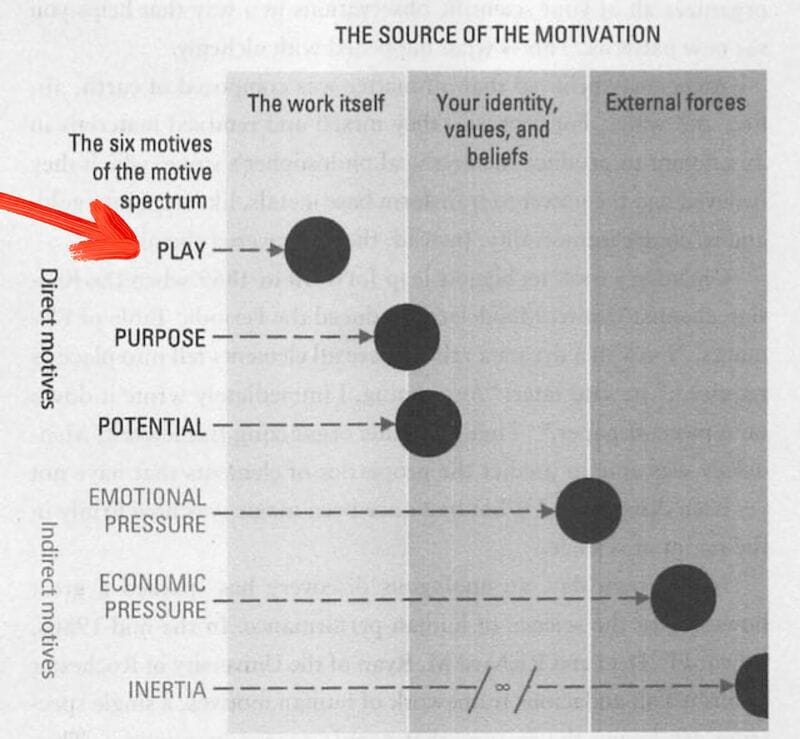
At the top: Play, Purpose, and Potential. These are direct motives. The work itself pulls you forward. You do it because it's inherently interesting, because it connects to who you are, or because it's building toward something meaningful.
At the bottom: Emotional Pressure, Economic Pressure, and Inertia. These are indirect motives. You're not pulled by the work. You're pushed by fear. Fear of judgment. Fear of going broke. Or worst of all, you keep doing it because you forgot why you started.
The majority of working professionals are in the bottom group. Our top performers and greatest contributors to society are all in the top three motives.
In other words, people operating from the top three motives consistently outperform people operating from the bottom three. Not by a little. By a lot.
Play isn't the opposite of productivity. It's the engine of it.
Clarke wasn't predicting a world of laziness. He was predicting a world where the highest-performing motive finally becomes available to everyone, not just the lucky few who happened to love their jobs.
AI is the unlock. It removes the drudgery that keeps most people stuck in the bottom half of the spectrum. It lets you spend your time on the work that actually matters to you, the work you'd do for free, the work that makes you lose track of time.
Again, we hear the alarm (AI = unemployment, oh no!) and miss the invitation to a brighter future (AI = we can... play and be more human?).
Rather than eliminating our responsibilities, play elevates them.
Raising children. Building communities. Solving meaningful problems. Exploring art, science, and your inner life. These are all made better, easier, with AI.
AI won't automatically give us that world. It could just as easily amplify inequality or leave people feeling purposeless. I'm not blind to that.
But I believe if we can respond with curiosity and optimism, instead of paralysis and doom, we can start separating our worth from our labor. We can re-anchor what it means to be human to something far more interesting than survival.
For the first time in history, technology may make it possible for huge numbers of people to not be organized primarily around fear. That's a world I'm excited to see. Because it leaves us with an exhilarating question:
Who do we become when we are no longer afraid?
Member discussion